

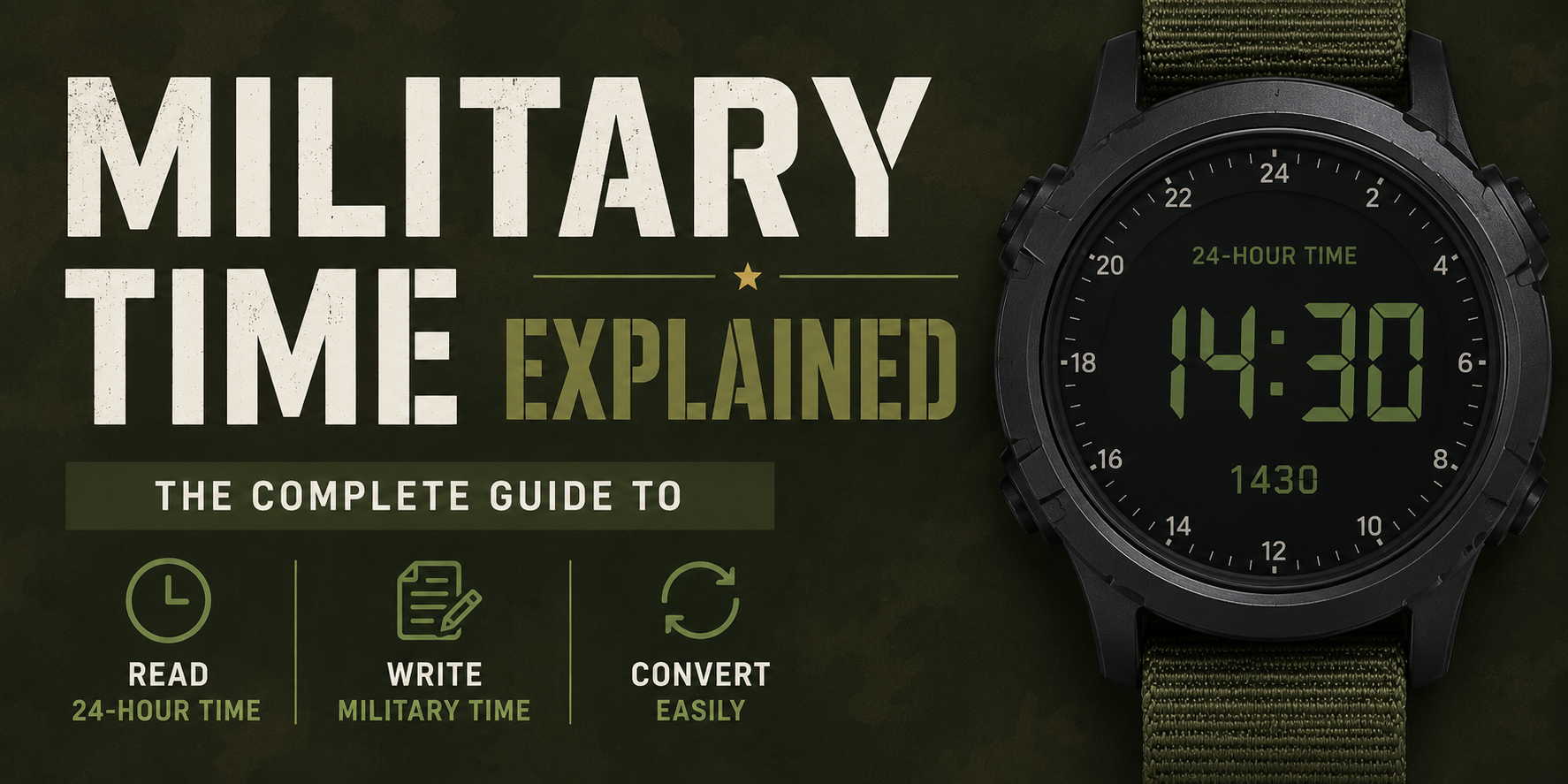
Whether you just started a job in healthcare, joined the military, or keep seeing “1730” on a work schedule and have no idea what that means — this guide breaks it all down simply.
Military time (also called 24-hour time) is used by the military, hospitals, emergency services, airlines, and workplaces around the world. Once you understand the simple logic behind it, converting between standard time and military time becomes second nature.

What Is Military Time?
Military time runs on a 24-hour clock instead of the standard 12-hour AM/PM system. Instead of resetting at noon and running from 1 to 12 twice a day, the 24-hour clock runs continuously from 0000 (midnight) to 2359 (one minute before the next midnight).
The main advantage: no confusion between AM and PM. When a schedule says 0800, everyone knows that means morning. When it says 2000, everyone knows that means 8 at night. No guessing, no mix-ups.
How to Read Military Time
Military time is always written as a 4-digit number:
- The first two digits represent the hour (00 through 23)
- The last two digits represent the minutes (00 through 59)
Examples:
- 0630 = 6:30 in the morning
- 1200 = noon
- 1545 = 3:45 in the afternoon
- 2300 = 11:00 at night
When spoken aloud, military time is read differently from standard time. “1430” is said as “fourteen thirty” — not “two thirty PM.” Hours before 1000 are often spoken with the word “zero”: 0800 is “zero eight hundred” or “oh eight hundred.”
Military Time Conversion Chart
Use this quick-reference chart to convert between standard time and military time:
| Standard Time | Military Time | Standard Time | Military Time |
|---|---|---|---|
| 12:00 AM (Midnight) | 0000 | 12:00 PM (Noon) | 1200 |
| 1:00 AM | 0100 | 1:00 PM | 1300 |
| 2:00 AM | 0200 | 2:00 PM | 1400 |
| 3:00 AM | 0300 | 3:00 PM | 1500 |
| 4:00 AM | 0400 | 4:00 PM | 1600 |
| 5:00 AM | 0500 | 5:00 PM | 1700 |
| 6:00 AM | 0600 | 6:00 PM | 1800 |
| 7:00 AM | 0700 | 7:00 PM | 1900 |
| 8:00 AM | 0800 | 8:00 PM | 2000 |
| 9:00 AM | 0900 | 9:00 PM | 2100 |
| 10:00 AM | 1000 | 10:00 PM | 2200 |
| 11:00 AM | 1100 | 11:00 PM | 2300 |
The Simple Conversion Formula
You don’t have to memorize the chart. There’s a simple rule:
Standard Time → Military Time:
- AM hours: Drop the colon and add a leading zero if needed. 9:00 AM → 0900. 11:30 AM → 1130.
- PM hours: Add 1200 to the hour. 3:00 PM → 3 + 12 = 15 → 1500. 7:45 PM → 7 + 12 = 19 → 1945.
- 12:00 AM (midnight) = 0000
- 12:00 PM (noon) = 1200
Military Time → Standard Time:
- If the number is 1200 or less, it’s AM. 0930 = 9:30 AM.
- If the number is 1300 or more, subtract 1200 to get the PM hour. 1800 − 1200 = 6 → 6:00 PM.
- 0000 = 12:00 AM (midnight)
- 1200 = 12:00 PM (noon)
Military Time at Work
Military time shows up in more jobs than people expect:
Healthcare: Nurses and doctors use military time to avoid dangerous medication errors. “Give medication at 6 PM” is ambiguous. “Give medication at 1800” is not.
Emergency services: Police, fire, and EMS dispatch use military time in reports and communications for the same reason — precision matters when seconds count.
Transportation: Airlines, railways, and shipping operations use 24-hour time globally. Your flight departure time in Europe or Asia is almost always listed in military format.
Security and law enforcement: Incident reports, shift logs, and surveillance systems commonly use military time for consistency.
Food service and hospitality: Many restaurants, hotels, and event venues use 24-hour scheduling internally for staff shifts.
If you’re starting a new job in any of these fields, getting comfortable with military time before day one is a small thing that makes a big difference.
Military Time in Daily Life
You don’t have to work in the military or healthcare to encounter 24-hour time.
- International travel schedules often display departure and arrival in 24-hour format.
- Many smartphones and digital clocks let you switch to 24-hour display in settings.
- European countries widely use 24-hour time in everyday life — written on signs, menus, and timetables.
- Smart home devices and scheduling apps often support 24-hour format.
- Some people prefer to set their own phone to 24-hour time simply to avoid AM/PM confusion.
How to Practice Quickly
The fastest way to get comfortable with military time is repetition with low stakes. A few easy ways to practice:
Change your phone clock. Go into Settings → Display → Time Format and switch to 24-hour. Within a week it’ll feel natural.
Convert times you already know. Every time you check the clock in regular life, mentally convert it. 2:30 PM → 1430. 7:15 AM → 0715. Do it enough and it becomes automatic.
Use the “subtract 1200” rule for PM. If you see any military time over 1200, just subtract 1200 and you’ve got the PM hour. 1945 − 1200 = 745 = 7:45 PM.
Print or bookmark the chart. Having it visible during the first few weeks on a job where military time is standard can save a lot of mental math.
Common Mistakes to Avoid
Confusing midnight and noon. Midnight is 0000. Noon is 1200. This trips people up the most.
Forgetting the leading zero. Military time is always 4 digits. 9 AM is 0900, not 900.
Adding a colon. Military time is written without a colon: 1430, not 14:30. (Though in some civilian contexts and international settings you’ll see it both ways.)
Using 2400. The convention is 0000 for midnight, not 2400 — though you may occasionally see 2400 used to mean “the end of the day” in certain scheduling contexts.
Military time isn’t complicated — it just takes a little adjustment if you grew up on a 12-hour clock. Once the logic clicks, it actually feels cleaner and more precise than the AM/PM system.
Whether you need it for a new job, international travel, or just want to finally understand what your coworker means when they say “meet me at fifteen hundred” — now you know.
Did this guide help? Bookmark the conversion chart above and share it with someone who’s been baffled by military time!
Got questions or want us to cover more everyday life skills like this? Leave a comment below.