

If you’ve never driven through Figueroa Street after midnight, you probably think LA shuts down when the sun goes down. It doesn’t. In fact, for a lot of people out here, the night is when life really starts.
As an Uber driver in South LA, I’ve seen things most people never see — not because they’re hidden, but because most people aren’t out there at 2 AM picking up strangers and navigating streets that tell a completely different story than what you see during the day.
This is one of those stories.
Figueroa Street After Dark
Figueroa Street runs through the heart of South Los Angeles. During the day it’s businesses, traffic, taco stands, and people going about their lives. Nothing unusual. But once the sun drops and the street lights kick on, the whole energy shifts.
I was out doing rides one night — regular pickups, nothing special — when I found myself rolling down Figueroa around the late hours. GoPro running, dashcam on, just documenting the city the way I always do.
What I saw wasn’t shocking to anyone who knows LA. But if you’re new to the city or you’ve only ever seen the tourist version of Los Angeles — the Hollywood sign, the beaches, the Sunset Strip — this is a side they don’t show you in the brochures.
The Street Economy Nobody Talks About
There’s a whole economy that operates on Figueroa at night. And it’s been there for decades.
Women standing on corners. Cars slowing down. Transactions happening in plain sight under the glow of street lights, right next to ordinary businesses — tax prep offices, beauty supply stores, corner markets — that won’t open again until morning.
It’s one of those things where you’re driving through and you realize: this is just part of the city. It’s not hidden. It’s not underground. It’s right there on the street, a few miles from Downtown LA, happening every night.
As a driver you see it differently than most. You’re not walking through it. You’re not a part of it. You’re just passing through, picking up your passenger, and moving on. But your camera catches everything.
What the Camera Captured

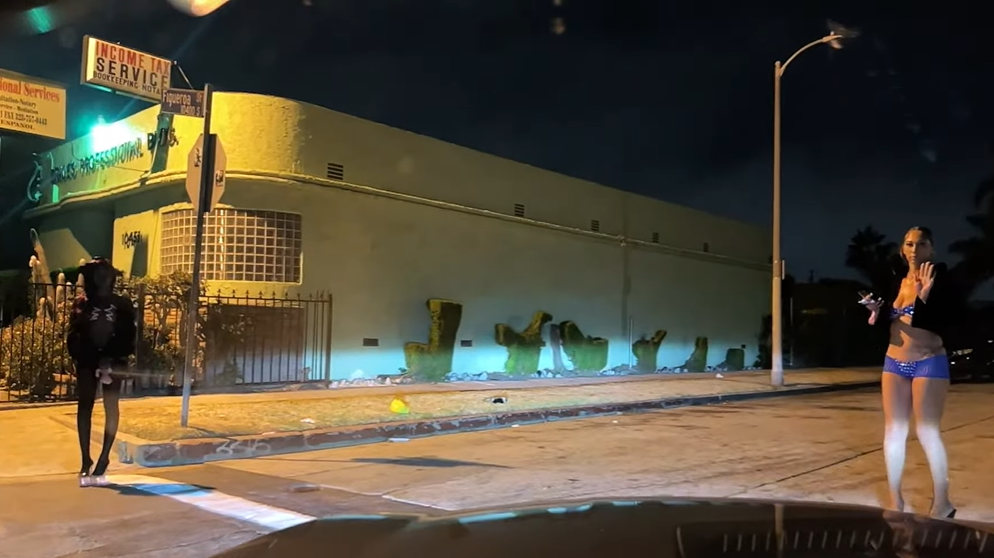
My dashcam footage from that night shows exactly what Figueroa looks like after midnight. The street is quiet but not empty. The lighting is that yellow-orange glow from the city grid. And on the corners, you see people out there working — in the only way available to them at that hour.
I’m not here to judge anybody. This channel is about documenting real life in Los Angeles — the whole picture, not just the clean version.
The reality is that Figueroa Street at night is a mirror of a lot of things wrong with this city. Poverty. Lack of opportunity. The gap between the LA you see on TV and the LA that actually exists for a lot of people.
The Contrast That Hits Different
What really gets you is the contrast.
Right there on that same block — an income tax service office. A bookkeeping and notary business with signs in English and Spanish. Normal, everyday small businesses serving the community. Closed for the night, dark windows, iron gates locked up.
And right in front of them, the street is alive in a completely different way.
That contrast — the everyday and the desperate existing in the same frame — is what Los Angeles actually looks like if you’re out here driving at night.
Why I Document This
Some people might wonder why a rideshare driver is out here with a GoPro and a dashcam filming the city at 2 AM.
Simple answer: because nobody else is telling this story from this perspective.
There are documentaries about LA poverty. There are news reports about crime on Figueroa. But there aren’t many regular people — drivers, workers, people just out here trying to make their money — showing you what they actually see night after night from behind the wheel.
That’s what Diaries of a Pedestrian is. No scripts. No production team. Just real footage from real nights in a real city.
South LA Is More Than Its Struggles
I want to be clear about something: South LA is not just what happens on Figueroa at night. This is a community with deep roots, strong families, incredible food, and real culture.
Compton, Watts, South Central, Long Beach — these are neighborhoods with history and pride. The street life I document is part of the story, not the whole story.
But ignoring it doesn’t make it go away. So we document it, talk about it, and maybe somebody watching from across the country or across the world gets a more honest picture of what life looks like out here.
Final Thoughts
If you ride with me on stream or watch my videos, you already know — I don’t sugarcoat LA. I show it as it is. Figueroa Street at night is just one chapter.
There are more nights. More streets. More stories.
Stay tuned to Diaries of a Pedestrian for more real LA content from a driver’s point of view.
🎥 Watch the livestream footage on YouTube: @DiariesofaPedestrian
Lo Que Pasa en las Calles de Los Ángeles de Noche
Para mis seguidores que prefieren leer en español:
Como conductor de Uber en el sur de Los Ángeles, he visto cosas que la mayoría de la gente nunca ve. La calle Figueroa de noche es un mundo completamente diferente al que existe durante el día.
Lo que mi cámara captó esa noche es la realidad de muchas personas que viven y trabajan en las calles de South LA — una realidad marcada por la pobreza, la falta de oportunidades, y el contraste entre el Los Ángeles que sale en televisión y el que existe para miles de personas cada noche.
No estoy aquí para juzgar a nadie. Estoy aquí para documentar la ciudad tal como es — honesta, cruda, y real.
Eso es Diaries of a Pedestrian — historias reales desde el volante de un conductor en Los Ángeles.
Sígueme en YouTube: @DiariesofaPedestrian
Figueroa Street at night, LA street life, Uber driver POV, South Los Angeles, night driving Los Angeles, what happens in LA at night, South LA documentary, rideshare driver stories, Los Angeles street documentary, Diaries of a Pedestrian, calle Figueroa de noche, sur de Los Ángeles, conductor de Uber Los Ángeles