

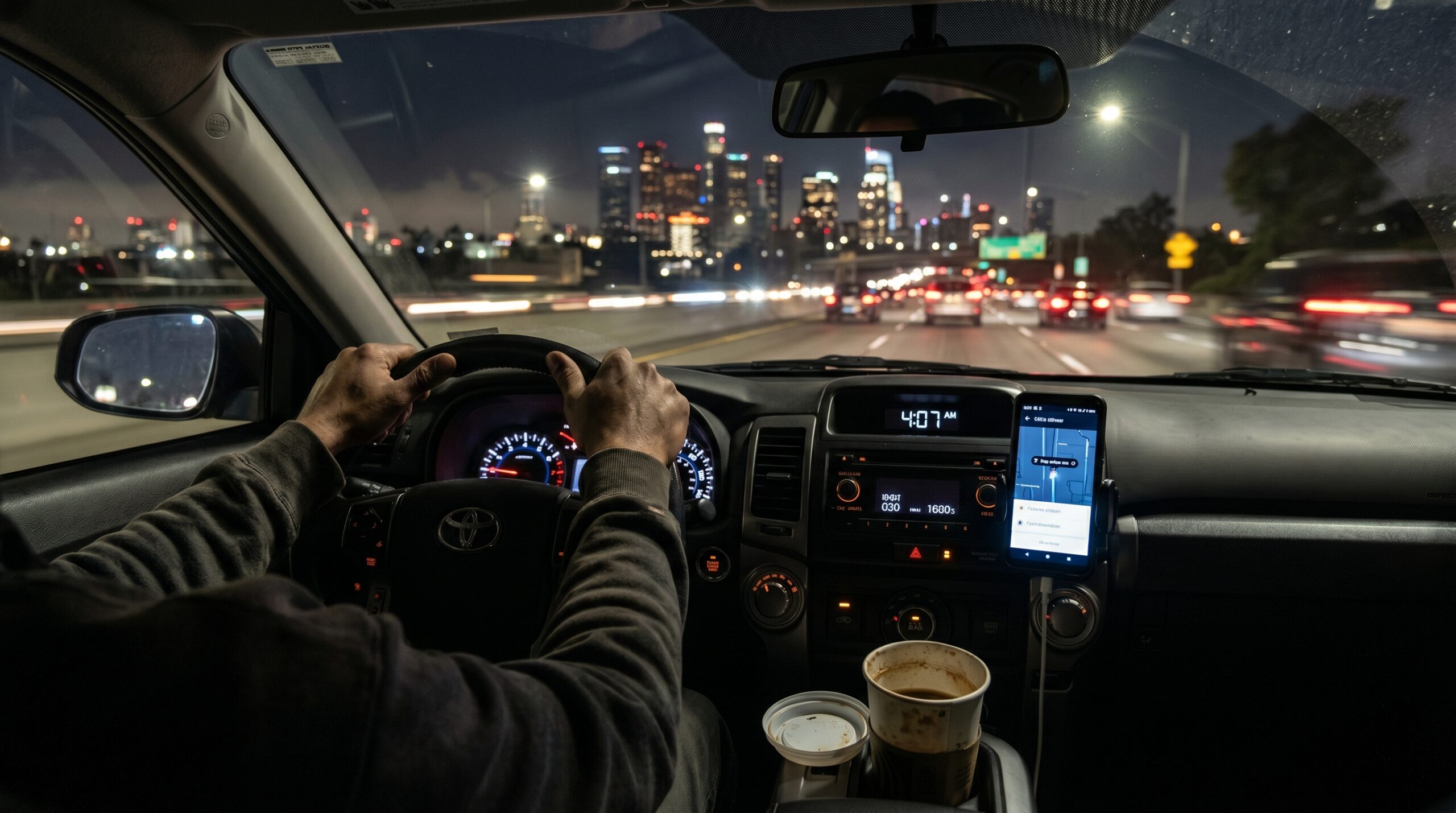
I’ve been in enough Ubers at 2, 3, 4 in the morning to know the ones who are struggling. You can tell. The lane drift. The over-correcting. The guy who jumps when you ask him to turn left because he forgot you were there. Sleep deprivation behind the wheel isn’t a vibe problem — it’s a life-or-death problem. And nobody talks about it enough.
Uber drivers on the night shift are out here carrying people home from bars, clubs, airports, late shifts of their own — and doing it on fumes. The gig economy doesn’t clock you out. There’s no foreman walking the floor telling you to go home. You drive until you stop, and for a lot of drivers, the money is better at night so stopping feels like losing.
Let’s talk about what’s actually happening out there.
The Numbers Are Ugly
Drowsy driving kills over 1,500 people a year in the US and causes more than 100,000 police-reported crashes. Here’s the part that should hit you: being awake for 24 straight hours is the equivalent of a .10 blood alcohol level. That’s legally drunk. That’s the person you’re getting in the car with when your driver has been on the road since noon and it’s now 4 AM.
Uber has a policy — drivers are supposed to take six hours of rest between every twelve hours of work. A drowsy driving complaint can lock a driver out of the app for six hours, and repeated complaints can get them deactivated permanently. That sounds serious until you realize Uber has no way of knowing if you slept or just sat in a parking lot for six hours scrolling your phone. The honor system doesn’t drive the car.
What Keeps Drivers Up
The late-night window — roughly 10 PM to 3 AM on weekends — is when the surge pricing kicks in. That’s when you can make real money in a short time. So drivers who’ve already been on the road all evening push through because the math makes sense in the moment and the fatigue sneaks up slow. Nobody falls asleep thinking they’re about to fall asleep. That’s the whole problem.
The body has two natural crash windows: midnight to 6 AM, and 1 PM to 3 PM in the afternoon. During those hours your circadian rhythm drops whether you like it or not. If you’re a night shift driver you are fighting biology for a surge bonus, and biology has never lost that fight long-term.
What Actually Works (And What Doesn’t)
Here’s the honest list.
Caffeine helps — briefly. Coffee and energy drinks buy you maybe 30 to 45 minutes of sharper focus. They don’t replace sleep and they will not save you at hour 14. Using them to push past the point where you should’ve stopped is how people end up in ditches.
Cold air and loud music help — briefly. Rolling the windows down, cranking the radio, slapping yourself in the face — these are temporary fixes that feel like solutions. They are not solutions. They are the early warning system telling you it’s time to pull over.
A 20-minute nap is real. If you feel it coming on, find a parking lot. Set a timer. Twenty minutes of sleep — not 45, not an hour, because you’ll wake up groggy — actually resets the brain for a couple more hours. This is science, not weakness.
Hydration matters more than people think. Dehydration makes fatigue worse. Not dramatically, but at the margins, and at 3 AM the margins are everything. Keep water in the car. Drink it.
The only real answer is sleep before you drive. Seven to nine hours. If you didn’t get it, a 20-minute nap before you start your shift helps. None of the tricks work without that foundation.
Know When to Stop
If you’re yawning every couple of minutes, you missed the signal. If you can’t remember the last few miles you drove, you’re already in danger. If your eyes are burning and your head is bobbing, you are not going to make it home with just willpower. The car knows before you do — that’s what the lane drift is telling you.
Pull over. Text your next rider an apology. Log off the app. The five-star rating is not worth what happens when you fall asleep doing 60 on the highway.
From the street, as a pedestrian who shares the road with you every night: we need you out there. Just not like that. Get some sleep. Come back tomorrow.