

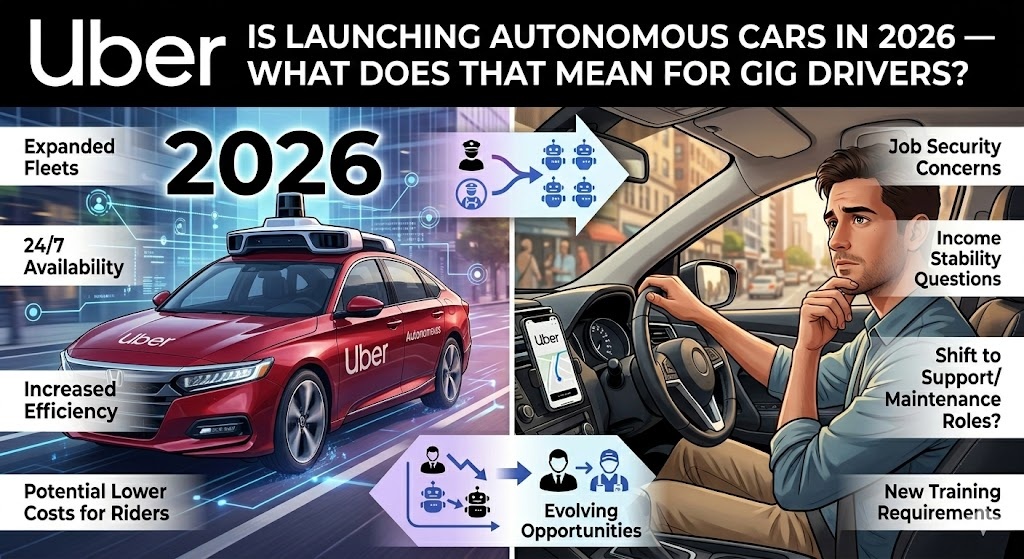
It’s not a rumor. It’s not a distant prediction. It’s happening right now — and if you drive for Uber or Lyft, you need to understand exactly what’s coming and what it means for your livelihood.
In 2026, autonomous vehicles aren’t science fiction anymore. They are on the road in American cities today, picking up real passengers, completing real trips — without a human driver behind the wheel. The robotaxi era has arrived. And the companies deploying them have billions of dollars betting that it’s not going back.
What Uber Is Actually Doing
Uber has committed more than $10 billion toward building out its autonomous vehicle future. Here’s what that looks like in practice:
- In July 2025, Uber signed a deal to purchase a minimum of 20,000 Lucid vehicles equipped with Nuro’s Level 4 autonomous driving systems over a six-year period — with production beginning in 2026
- In January 2026, Uber launched “AV Labs” — a new internal division specifically designed to gather driving data for its robotaxi partners and accelerate autonomous deployment
- Uber is also taking equity stakes in autonomous vehicle companies, meaning it profits more when robots replace the humans it used to pay
- The company has plans to launch robotaxi services in at least 15 cities in the near term
Let that sink in: Uber is building a division whose entire job is to replace you with a robot — and they launched it this year.
It’s Not Just Uber — The Whole Industry Is Moving
Uber isn’t alone. The entire rideshare and transportation industry is sprinting toward autonomy simultaneously.
Waymo is the furthest along. As of mid-2026, Waymo is completing over 500,000 paid rides per week across 10 US cities and is aggressively expanding — with 20+ cities planned and international launches in Tokyo and London on the horizon. Their target is 1 million rides per week by end of 2026. Waymo operates on Uber’s platform in Austin and Atlanta right now — meaning when you open the Uber app in those cities, you might be dispatched a car with no driver.
Tesla launched its unsupervised robotaxi service in Austin in early 2026 and has already expanded to Dallas, Houston, Phoenix, Miami, Orlando, Tampa, and Las Vegas — with 7 more cities announced. Their Cybercab, a purpose-built driverless vehicle, entered mass production in April 2026.
Zoox (owned by Amazon), Cruise (GM), and several other players are all in various stages of deployment. In San Francisco alone, by late 2026 there could be four competing robotaxi services running simultaneously: Waymo, Zoox, Tesla’s Cybercab, and Uber’s own Lucid-Nuro vehicles.
How Fast Is This Actually Coming for Drivers?
Here’s the honest answer: not overnight — but faster than most people expect.
Right now, autonomous vehicles face real limitations. They struggle in bad weather (heavy rain, snow), in complex construction zones, in cities with unpredictable traffic patterns, and in suburban and rural areas where road infrastructure isn’t as standardized. A robotaxi that works perfectly in Phoenix’s wide, sunny, grid-layout streets may not work at all in Boston’s winter or New Orleans’ narrow historic districts.
That means the displacement of human drivers will happen unevenly by geography. Drivers in Phoenix, Austin, Dallas, Los Angeles, and San Francisco are closest to the front line. Drivers in smaller cities and suburbs have more runway.
The pattern will likely go like this:
- 2026–2027: Robotaxis handle a growing share of simple, predictable trips in major sunny-weather cities. Human drivers start seeing fewer rides during off-peak hours as AVs absorb the easy routes
- 2028–2030: AV coverage expands to more cities, more weather conditions, more route types. Surge opportunities for human drivers shrink as the fleet scales
- 2030+: In major metros, human rideshare driving becomes a niche — premium service, complex routes, accessibility needs — while robots handle the volume
Fortune magazine called the Massachusetts drivers union win “the biggest labor win since 1941 — just before the robots arrive.” That framing is right. The window to lock in protections is now, not later.
What Uber Says — And What They’re Not Saying
Uber’s public messaging to drivers has been careful. The company says autonomous vehicles will “unlock new opportunities” and that human drivers will remain essential for the foreseeable future. They point out that AVs currently operate in limited zones, that demand for rides is growing overall, and that the transition will be gradual.
What they’re not saying out loud: every successful AV ride is one less ride that gets dispatched to a human driver. Every city that Waymo or Tesla robotaxis enter is a market where Uber’s labor costs drop. The company’s investor presentations make the math clear — autonomous vehicles mean higher margins, and higher margins are the goal.
Uber also recently turned on Waymo — shifting billions away from its Waymo partnership and into building competing AV fleets with Rivian and Lucid. That tells you something: they’re not content to just be a platform. They want to own the cars and eliminate the driver entirely from their cost structure.
What Drivers Are Doing to Fight Back
The good news — and it is real — is that drivers aren’t sitting still.
The App Drivers Union in Massachusetts, certified in May 2026 as the first rideshare union in US history, has made AV protections one of their top bargaining demands. They want contract language guaranteeing transition plans — not sudden account shutdowns when a robotaxi enters their city. They want to know in advance, be given options, and have a say. Read our full breakdown of the union here.
Labor organizers in California, New York, and Illinois are watching Massachusetts closely. If the union secures meaningful AV protections in their contract, it becomes a template other states can push for.
What Should You Do Right Now?
If you’re a gig driver, here’s practical advice for navigating the next few years:
- Know your city’s timeline. If you drive in Phoenix, Austin, Dallas, LA, or SF — the AV pressure is real and coming soon. If you drive in smaller markets, you have more time but should still plan
- Diversify your income streams now. Multi-app, delivery, rental car driving, driving instructor licensing — don’t put all your income in one app basket
- Build transferable skills. Logistics, fleet management, AV safety monitoring (humans are still required to oversee autonomous fleets in many jurisdictions), and customer service roles are growing as the AV industry scales
- Stay informed and organized. Follow what the App Drivers Union negotiates. If your state starts a similar organizing push, pay attention — your job protections may depend on it
- Max your earnings while the window is open. The next 2–3 years are likely the peak earning window for human rideshare drivers in major cities. Run smart, run strategic, and stack as much as you can. We broke down exactly how to do that in this guide.
The Bottom Line
Uber going autonomous isn’t a maybe — it’s a when. The question for every gig driver is not whether to be worried but how to use the time you have wisely.
The robots are coming. But they’re not everywhere yet. And in the window between now and when they are, there is real money to be made, real fights to be won, and real decisions to make about what comes next for your career.
Don’t wait to be disrupted. Get ahead of it.
Are you worried about autonomous vehicles taking over rideshare? Tell us what city you drive in and what you’re thinking in the comments below.